
by Debra Lau Whelan
Kara Bodegón-Hikino went from covering bands to drawing a two-legged pink shark. Her debut graphic novel, “Squalo & Mage vs. the Rage of the Bakunawa” (HarperCollins, 2026), follows a young girl and her bestie on a quest to carry out her late father’s final wish: to find Bakunawa, a powerful sea dragon from Filipino folklore.
As a kid, Bodegón-Hikino dreamed of becoming a marine biologist, an artist, and a musician—and in some ways, she did. Born and raised in Manila, she studied multimedia arts at De La Salle-College of St. Benilde, worked as a graphic designer, and later earned an MFA in creative writing before spending more than a decade in the music industry writing for publications like Billboard, Bandwagon Asia and PULP Magazine. But that little girl, who always spent her spare time doodling and filling entire notepads with handwritten stories, never really left.
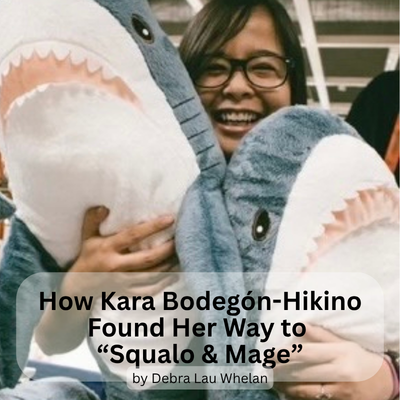
“Squalo & Mage”—inspired by a shark plushie and the Filipino pop song Kung ‘Di Rin Lang Ikaw—started out as a fun comic Bodegón-Hikino posted on social media. Then, in 2019, she submitted her idea to DVPit, a virtual event that highlights unpublished, marginalized voices. That move led to her signing with a literary agent and eventually landing her first book deal.

While readers will find the same playful, upbeat spirit of the original comic, the fantasy graphic novel also explores fear, courage, kindness, and grief. Bodegón-Hikino knows that last one firsthand, having lost her father during the pandemic.
She currently lives in Manila with her husband and toddler son. We caught up with her to talk about perseverance, loss, motherhood, and the importance of making time for yourself.
A teacher once called you “stupid” for writing stories and doodling in class. Did that voice ever creep back in during the five years it took you to finish “Squalo & Mage?”
Honestly, not really. I look back at that moment with eyes rolling. What kept me going was the dream itself. Out of the hundreds of things I wanted to be when I grew up, the one dream that stayed consistent was becoming an author. I was always writing stories when I should’ve been listening in class or being a proper office employee.
Where did you draw inspiration for the book?
The story of “Squalo & Mage” is mine, and while I did borrow elements from Filipino and Japanese folklore, this was a story that only I could tell. Looking back now, I realize that this book has my entire soul in it. My love for music, video games, and fantasy stories all rolled into a 240-page graphic novel.
What does a graphic novel format allow you to do that a traditional novel doesn’t?
Having a walking pink warrior shark is enough reason to tell this story as a graphic novel! As much as I also love writing traditional novels—I’m working on a contemporary YA novel about the music scene—a story like “Squalo & Mage” fits better in a graphic novel format, especially since I included all sorts of silly gaming elements and cameos of artists from the Filipino music world.
Why did you finally leave music journalism to become a full-time author-illustrator?
I realized I couldn’t do both at the same time. I always had music journalism at the forefront and my illustration work on the side. But I scored the book deal for “Squalo & Mage” while I was still working a day job, and I struggled with the whole balancing act.
Music journalism was very demanding of my time. There was constantly breaking news to write, interviews to conduct and transcribe, and shows to review, so by the end of the night, I’d be too tired and sleepy to work on my graphic novel, which needed just as much time and attention.
There’s clearly a huge shift in skill sets. What else is different about the way you work now?
I needed to work on my focus. I have a short list of mental health issues—ADHD being one of them—so there was a lot of disciplining myself to sit down and work, work, work and defeat my task paralysis monster. I work best at our neighborhood coffee shops, especially after becoming a mom.
You’ve talked about losing touch with your creative spark after becoming a mother. What helped you reconnect with your creativity, and how important was self-care?
I can tell you exactly the weekend it happened: it was at Graphika Manila 2025, this annual conference on creativity and design here in Asia. After being practically attached to my son for two years, I finally had a weekend away to myself to recharge my creative spark.
It’s difficult to bounce back immediately after becoming a first-time mom, maybe unless you’re a Kardashian! It really does take a lot of time, perseverance, and patience with yourself to climb out of any hole you’re in. So it’s very important to get me-time. My me-time gives me enough breathing time to recharge and remind myself that I’m more than just a mother; I’m still an artist. Me-time is sacred and must be respected.
What has creating this book taught you about your own resilience?
“Squalo & Mage” is the biggest project I’ve ever tackled. It was also this huge training arena, where I learned everything it takes to make a graphic novel. It’s not easy, and there were many moments that made me want to tap out, but I knew I couldn’t give up. Bringing a book out into the world was the dream, and it’s so cool that it’s no longer just a dream.
Was there a time in your career when you moved forward despite uncertainty?
I’d say it was when I shifted from graphic design to music journalism. My first boss always told me I was a good writer, even though I always refused to write for her. Back then, I thought I could only write fantasy and YA contemporary fiction, not articles. The first story I wrote for a magazine was about my experience at this heavy metal festival here in the Philippines, and after submitting it, the editor-in-chief offered me a job. I was in shock. This was my dream since I was 12 years old, and I had to take it. There was a lot of learning the ropes on my own while I was there, but boy was it crazy fun.
Your father passed away during the pandemic, so grief was a backdrop for this story. How did loss affect your storytelling?
It’s been a rough five years, but grief and motherhood opened me up to emotions I hadn’t known until it became my reality. In the weeks following my dad’s passing, I wrote two short stories about our life and another about us being whale sharks. I’m not sure if they’ll ever see the light of day, but writing them reminded me of the things that I’m good at.
Mage’s journey begins with the loss of her father. Why was it important to portray grief and healing as something gradual rather than something that can be solved?
Grief comes in waves. One moment you can have the greatest day ever, but then you come across a trigger, and you can just spiral. But that’s OK. Grief isn’t only this dark and depressing thing; when you grieve a family member and miss them terribly, it means you lived with love, and I think it’s important for people to know that.
You’ve also talked about grieving the life you had before motherhood. How has becoming a mother changed your sense of identity?
While motherhood completely changed my life forever, another kind of grief became a part of my reality—grieving the life I once had. Don’t get me wrong, I love being a mom and love watching my kid grow into this really cool dude, but I honestly do miss the writer I used to be. I don’t get to write as much these days. I’m a different person now. I guess, in a way I’m still the same, but a leveled up version of myself with a new set of priorities. Plus, with my kid, I now end up discovering other worlds and adventures through his imagination.
Your book introduces readers to Filipino folklore, culture, and music. What do you hope these traditions will bring to an international audience?
It’s about time more people learned about Filipino culture and creatures from our folklore. They’re just so dang cool. There are so many different creatures—both wonderful and equally terrifying—that could easily inspire countless stories, especially for aspiring writers and artists. There’s a lot to learn, not just from their lore, but also from the values they can teach us.
What were you searching for as a young reader that you hope today’s kids find in “Squalo & Mage”?
Back in the day, I would dream of Disney adapting “Noli Me Tangere” (Penguin) by José Rizal (“Touch Me Not” is an 1887 novel that exposes the corruption of the Spanish colonial government and the Catholic friars in the Philippines) or something from Filipino folklore into an animated film. I also had dreams about an Assassin’s Creed game set in the Philippines. Obviously, those things didn’t—or haven’t—been picked up yet, so I hope kids will recognize these little elements I borrowed from Filipino culture.
Why was it important to weave Original Pilipino Music (OPM) influences into the book?
Filipino music definitely plays a huge role in “Squalo & Mage.” Part of the bakunawa’s lore involves music, so I thought it would be really cool to weave in actual songs from Filipino music into the book. I borrowed the lyrics of a song by the Filipino rock band Sandwich for a pivotal scene in the story. I’m so grateful I got their blessing to use it.
Who are the women who helped shape the person you’ve become?
There are so many! But let’s stick to three—first is my mum, Darling. She’s the person who taught me—and continues to teach me—that I shouldn’t settle for less, and that there’s always room to build a better version of yourself. Then there’s my colleague-turned-bestie, Camille Castillo, who has been a big part of my mental health journey. And lastly, my first friend in the world, Monica Ramos, who showed me that it’s possible to have a career as an illustrator.
You’ve reinvented yourself more than once. Which version of Kara do you think was the bravest?
I can’t think of one specific version of Kara because each version was faced by a beast that required varying stats to defeat. Thirteen-year-old Kara made the decision to move back to Manila to be with her father and brothers after [her biological mother] dragged her away to Germany. Eighteen-year-old Kara was a big dreamer who wanted to write a fantasy novel, play drums in a band, live abroad—the list goes on—but she was stuck in her own head a lot. Twenty-four-year-old Kara was confident about her writing and had high hopes of making it into Hollywood as a screenwriter, while interning at a pop-punk indie label in LA, but she didn’t have the visa that would let her do it. Thirty-two-year-old Kara lost her dad and had to figure out life without her biggest supporter. I guess I’ll just have to land with present-day Kara. She went through all that, has gotten this far, and is still going.
As someone who’s had such a varied career, what advice would you give women who are trying to define success on their own terms?
It’s OK to want to do many things in life. You don’t have to restrict yourself to one profession or specific expectations. I think it’s great to explore whatever you can be and want to be. And most importantly, never let go of what makes you weird. That’s your superpower.
*Edited for clarity and length.