
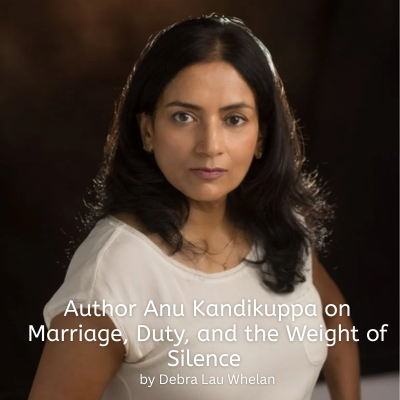
By Debra Lau Whelan
It took Anu Kandikuppa a decade to write the twelve stories in her debut collection, The Confines (Veliz Books, 2025). A former engineer and software developer, she started writing fiction in 2012 while working as an economics consultant and later earned an MFA from Warren Wilson College. Two years after graduating in 2015, she published her first story and began writing full time.
Born and raised in South India, Kandikuppa grew up in a world where women were expected to marry—and stay married. There were strict rules about how they spoke, dressed, and behaved. It’s not surprising that many of her stories focus on failing relationships bound by duty, obligation, and expectation. “These constraints, many of which I experienced firsthand, were on my mind as I wrote the stories,” she says.
Kandikuppa experimented with jeans her first year of college, but only wore Western clothes regularly after moving to the U.S. as a graduate student 30 years ago. Living in a new country also revealed something universal: domestic strife often plays out the same way in India and the U.S., with couples struggling to make it work.
Seven of the twelve pieces in The Confines stand alone, but “Please Don’t Make Me Hate You,” “Gardening,” and “The Uglies” trace the decline of Meenu and Adi’s marriage, while “Manu and Me” and “Hambug” explore the devastating impact of alcohol on Manu and his wife, Bela.
We spoke with Kandikuppa, who now lives outside Boston, about unhappy unions, the pressures women face, and what it means to stay together—or not.
The Confines is a perfect title. Can you talk more about the restrictions you faced growing up and whether some of them still affect you today?
Yes, in many ways I haven’t shaken off the culture. An obvious example is clothing—I still don’t choose dresses and tops with even slightly dipping necklines, which is a problem because most clothing is made for women with longer torsos.
I wrote about clothing in an essay in Lunch Ticket, an Antioch University literary magazine. And when I’m in India, old habits return, such as sitting with the women, eating after the men eat, serving food—and of course, I’m covered neck to ankle. It could be worse, though.

I read that you published this collection after realizing that unhappy marriages were such a common theme. You’ve been married for three decades and have grown children. How much of what you write is autobiographical and how much is fiction?
Like many of my characters, I grew up embedded in a conservative South Indian culture, and I met my husband at graduate school in the U.S., like Meenu and Adi, the couple in one of the linked story sets. I’m lucky to have had plenty of freedom growing up. My family was upper middle-class, English-speaking, and education-loving. I began working at a young age and lived and traveled alone. As I grew older, though—through no fault of my parents, but due to the environment and my own personality—I started to feel bad that I was still single.
The tension I felt then—and the fact that marriage in my world was almost always for life—was on my mind as I began writing stories, eventually helping cohere them. In that environment, it’s hard to say whether a long-standing marriage is so because it’s truly successful or because the partners have no choice. I’ve made up people and situations, of course, such as Meenu and Adi’s camping trip and the couple in “The Belfort.”
The women in your stories often endure silently and seem trapped in unhappy circumstances. Were you hoping to tell readers, “you’re not alone, and it’s okay to walk away” or did you have another message in mind?
One reason it felt worthwhile to bring these stories to readers is that they deal with aspects of culture not often written about. If a reader is angry or sad and discontent in a relationship and doesn’t quite know why, thoughtful writing about people in similar situations, fictional or otherwise, might help them understand their emotions.
What advice would you give those who see themselves in your characters and want to break free from the confines of their own unhappy lives?
I’m no counselor! But I suppose I’d suggest reaching a complete understanding of one’s situation, and trying to see how much of any sense of imprisonment is self-imposed and therefore in one’s control. When I was newly married, for example, I’d often feel compelled to adopt certain behaviors. For example, I’d wear Indian clothing at home and cook four-course meals every night when my in-laws were visiting, even when I had a demanding job. Perhaps that was unnecessary. Perhaps I burdened myself needlessly.
Your stories focus on Indian families in the U.S. and India, but the emotions you explore feel universal. Was it cathartic to write so honestly about long-term relationships and were you pleased with the response to the book?
I’m glad you think the emotions feel universal. The readers I’ve heard from—book club members, attendees at my book events—have been pleased and intrigued to read about Indian culture from a perspective not often addressed in fiction published in the U.S.
At a book club meeting I attended, the book sparked much discussion about “eve-teasing” (men making unwanted sexual comments to women in public) and divorce, and what India was like then and now. Writing is thinking, as they say, so, yes, it felt good to think deeply as I wrote these stories.
Your prose is emotionally powerful. How do you decide how much to reveal and what to leave unsaid in your stories?
Thank you. I think I generally default to saying less than more in a literary manner. It happens naturally through endless rounds of editing.
How did your family and friends respond to The Confines, and what would you like younger readers to take away from it?
My husband has always been very supportive of my writing. He read many stories when they were first published in journals, reacting to the creativity, the language, and the creative process rather than drawing parallels between the stories and our lives. (I’m particularly glad he didn’t assume the story about the couple quarreling viciously is about us.)
My kids attended one of my readings, bringing many of their friends, and once they got past the embarrassment of seeing their mom up there, I think they were proud. They and their friends were a very attentive, engaged audience. Even if the culture and situations described feel unfamiliar, I hope young readers take away the value of thinking through experiences and emotions and expressing insights in writing, whether fiction or non-fiction.
Tell us about the novel you’re working on and if you’re facing any challenges?
My novel-in-progress is very different from my short fiction so far. It’s a near-future speculative novel that imagines a machine has been invented that can do everything. The story follows a father who hates his job, his son who doesn’t want a job, and other characters in the months after the machine starts putting people out of work. In the novel, I ask: why are we so consumed by our jobs? What will we do if there is no work? Believe it or not, I began the novel way back in 2019. The challenges are many, structure and cohesion being the biggest.
*Edited for clarity and length.

Leave a Reply